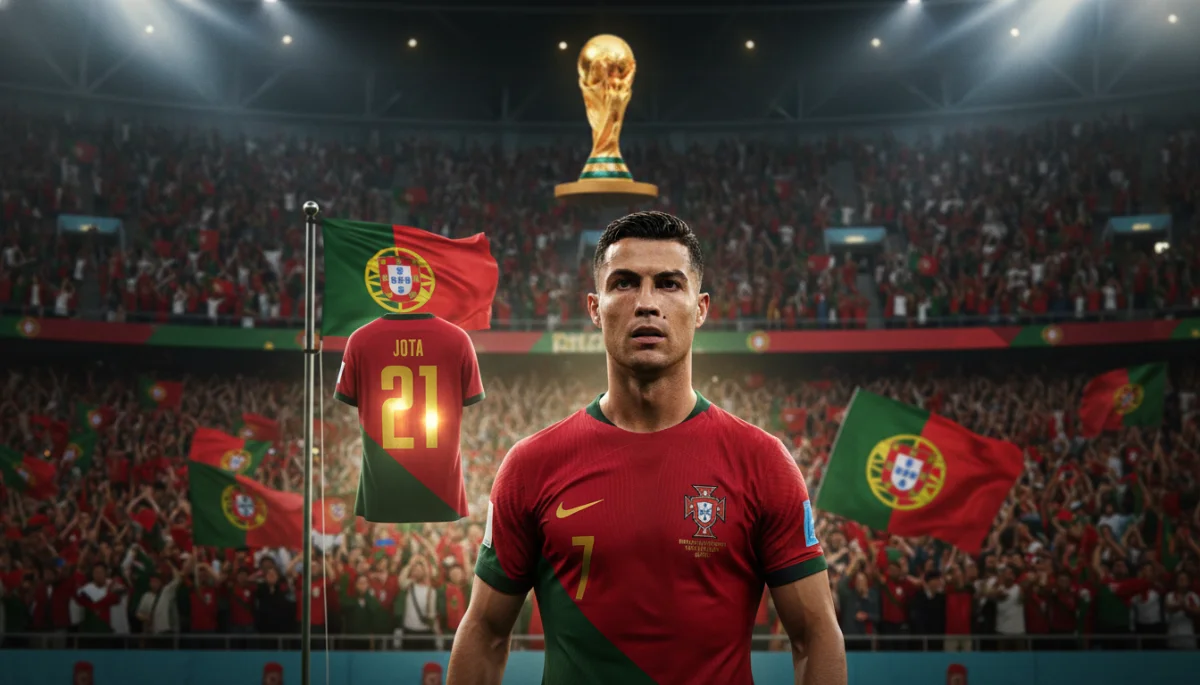
Portugal’s World Cup story is already carrying extra weight before a ball is even kicked. Roberto Martínez has named his squad, Cristiano Ronaldo is back to lead the line, and the team is preparing for a tournament that could become one of the most memorable in its history. Yet this announcement was not only about selection and tactics. It also served as a tribute to Diogo Jota, whose absence will be felt deeply by everyone around the national team.
Ronaldo Enters Another Defining Chapter
Cristiano Ronaldo remains the central figure in Portugal’s plans, and his inclusion immediately set the tone for the squad announcement. At 41, he is no longer the same player he was at the peak of his athletic powers, but his importance has not faded. His finishing, command of big moments, and ability to shape the mood inside a dressing room still matter greatly to Portugal.
If he plays in the tournament, Ronaldo will reach the extraordinary milestone of appearing in six different World Cups. That achievement would place him alongside Lionel Messi if the Argentina captain also takes part, and it would further underline just how long both men have defined the modern game. Ronaldo already stands alone in several major categories, including men’s international goals, total international appearances, and scoring in five separate World Cups.
For Martínez, the decision to keep Ronaldo in the squad is about more than nostalgia. Portugal still needs a player who can turn half-chances into goals, absorb pressure, and set the standard when the stakes rise. Ronaldo may no longer carry the team on his own, but he remains a powerful competitive force.
A Tribute That Gives the Squad Extra Meaning
The most emotional part of the announcement was the continued remembrance of Diogo Jota. The former Liverpool and Portugal forward died in a car crash in Spain last year at just 28, leaving a profound void in the sport and especially within Portuguese football. His loss remains painful, and the national team has made it clear that he will remain part of their journey in spirit.
Martínez described Jota as Portugal’s “plus one forever,” a phrase that captured both the sadness and the sense of unity surrounding the squad. Although tournament rosters are limited to 26 players, Portugal symbolically extended its group to 27 in honor of Jota. That gesture was not just ceremonial. It was a reminder that this team will carry his memory into every match, every huddle, and every decisive moment.
For Portugal, Jota’s presence will be felt as motivation rather than distraction. His legacy gives the squad a deeper emotional purpose, and that can matter as much as any tactical detail once the tournament begins.
Why This Portugal Group Looks So Strong
Portugal has arrived with one of the most complete squads in the competition. The balance is striking: veteran leaders at the top end of the pitch, technical midfielders in the center, fast and fearless wide players, and defenders who can protect the box while also contributing to buildup play. Martínez has options everywhere, and that flexibility gives Portugal a real chance to adapt from one opponent to the next.
Stable Options in Goal and Defense
The goalkeeping group gives Portugal a dependable base, with Diogo Costa expected to be the first choice and José Sá and Rui Silva providing experienced cover. Ricardo Velho has also been included, which adds depth in case injuries force changes during the tournament.
At the back, Rúben Dias is likely to anchor the defense, bringing organization, anticipation, and leadership. Around him, Portugal has a useful mix of full-backs and center backs who can handle different demands. João Cancelo and Diogo Dalot offer attacking width from deeper positions, while Nuno Mendes adds pace and recovery speed on the left. Gonçalo Inácio, Renato Veiga, and Tomás Araújo round out a group that gives Martínez both stability and versatility.
A Midfield Built to Control Games
Portugal’s midfield may be the team’s greatest strength. Bruno Fernandes and Bernardo Silva bring creativity, experience, and the ability to decide matches with one pass or one shot. Vitinha and João Neves add control and intelligence, while Rúben Neves and Samú Costa provide different forms of balance and security. Together, they give Portugal the ability to dictate tempo, press intelligently, and move the ball quickly into dangerous areas.
That variety is important because World Cup matches often hinge on whether a team can handle different game states. Portugal can play patiently, but it can also turn aggressive when the moment calls for it.
Attackers Who Can Change the Tempo
Up front, Portugal has enough talent to trouble any defense. Ronaldo remains the focal point when needed, but he is far from the only threat. Rafael Leão can break lines with pace and direct dribbling, João Félix offers invention between the lines, and Gonçalo Ramos gives the side a more natural central striker option.
Pedro Neto, Francisco Conceição, Gonçalo Guedes, and Francisco Trincão add even more variety, allowing Martínez to choose between width, pressing, combination play, and counterattacking speed. That mix should make Portugal difficult to predict, which is often a major advantage in tournament football.
The Group Stage Path Ahead
Portugal has been drawn into Group K, where it will meet Congo, Uzbekistan, and Colombia. On paper, that is not the kind of group that allows for any complacency. Portugal should be expected to compete for first place, but each opponent brings its own challenge, and tournament openers can be especially tricky.
The team is scheduled to begin its build-up on June 1, with warm-up matches against Chile on June 6 and Nigeria on June 10. Portugal will then travel to the United States on June 12 before opening its campaign against Congo in Houston on June 17. Those preparation games should help Martínez refine his combinations and settle on the best balance between control, pace, and attacking threat.
What Martínez Sees in This Squad
Roberto Martínez has been careful not to overstate Portugal’s status, even though the squad is clearly strong enough to dream big. He knows the difference between being a contender and being the outright favorite, and he has suggested that the title of favorite usually belongs to nations that have already won the World Cup. Portugal has not yet done that, but this team has given supporters reason to believe that the wait could finally end.
That belief has been reinforced by recent success. Winning the 2025 Nations League, including victories over Germany in the semifinal and Spain in the final, showed that Portugal can handle elite opposition under pressure. It also proved that this group has the mentality needed for knockout football, where small details often decide everything.
Why Portugal Could Go Deep
There are several reasons to think Portugal could be one of the tournament’s most dangerous teams. The squad has depth in almost every area, and that means injuries or rotation should not derail the overall plan. Ronaldo’s experience remains valuable, while the midfield gives the team a strong control center. The attack has pace and invention, and the defense has enough quality to survive difficult stretches without losing composure.
Just as important, the emotional thread running through the squad may sharpen its focus. Playing for Diogo Jota gives the team an added layer of purpose, and teams with that kind of shared motivation often find another level when the pressure rises.
Portugal’s Chase for Its First Title
For Ronaldo, this could be the final great World Cup chapter of an unmatched international career. For Martínez, it is a chance to shape a talented group into something historic. And for Portugal as a football nation, the tournament represents another opportunity to turn years of promise into a trophy that has never yet been won.
Portugal enters the World Cup with quality, depth, and real ambition. It also enters with a sense of loss that has been transformed into unity. Ronaldo is chasing history, Martínez is chasing the country’s first world title, and Diogo Jota’s memory will travel with them all the way.