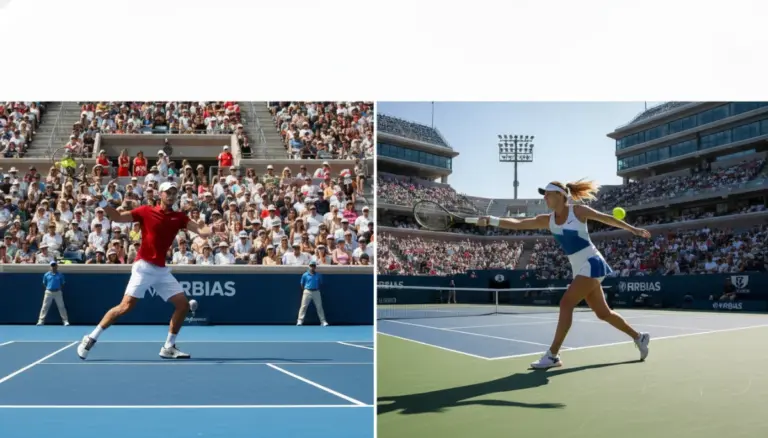
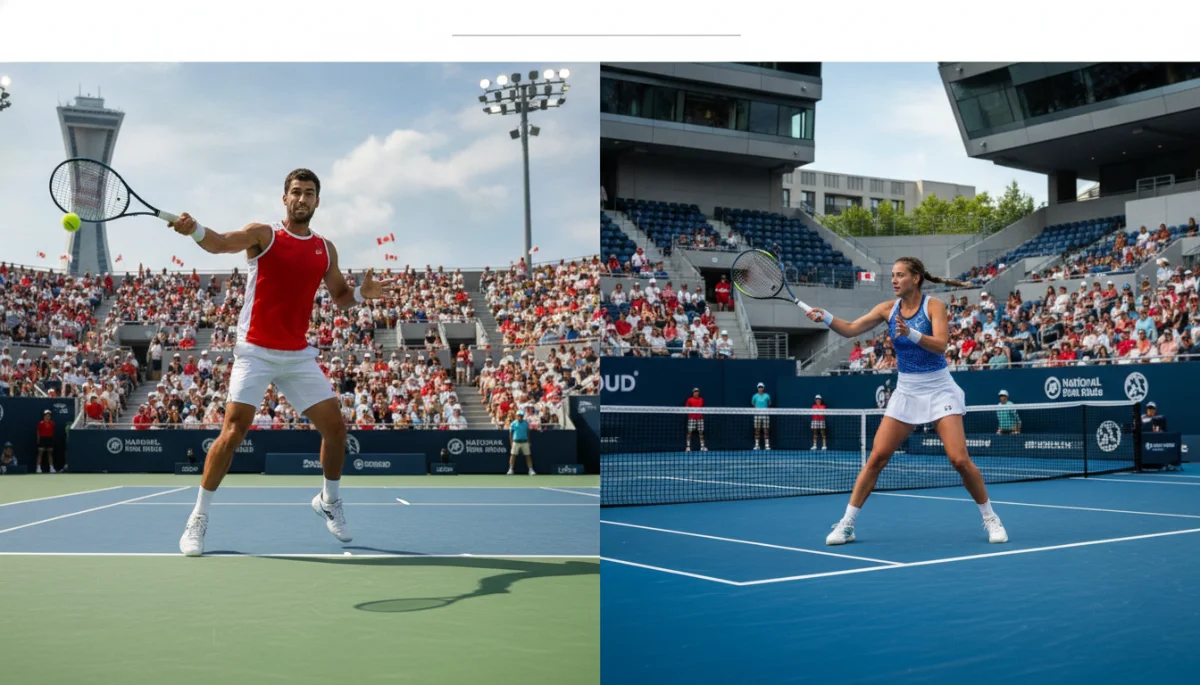
The National Bank Open reaches a decisive weekend, and both cities are packed with pressure, opportunity, and shifting momentum. Montreal’s men’s event has turned unpredictable, while Toronto’s women’s field still features several of the sport’s biggest names, all trying to secure a place in the quarterfinals.
By the end of the round of 16, only eight players will remain in each draw. That makes Saturday, August 8, and Sunday, August 9, a pair of must-watch days for anyone following the tournament closely.
A Fast Turn Into the Week’s Biggest Matches
The round of 16 is split across the weekend, with men’s matches in Montreal and women’s matches in Toronto. At IGA Stadium, the day sessions begin at 12:30 p.m., while evening play starts at 6 p.m. Toronto follows a slightly later rhythm, with center court opening at 12:30 p.m. during the day and 7 p.m. at night.
That schedule gives each city four singles matches per day, and it also sets up a clear path to the quarterfinals, which are slated for Monday, August 10, and Tuesday, August 11. The exact order of play usually arrives the day before each session, since weather, match length, and court availability can quickly reshape the lineup.
The timing matters because this stage often separates players who can handle pressure from those who only look strong in the opening rounds. Once the field narrows, every point becomes more expensive, and the difference between a deep run and a quick exit can come down to a single service game.
Montreal’s Men’s Draw Has Lost Its Favorites
Montreal has already produced a surprising number of exits, and that has completely changed the shape of the men’s bracket. Alexander Zverev, Daniil Medvedev, Taylor Fritz, and Andrey Rublev all went out early, while Félix Auger-Aliassime, the second seed, withdrew because of a back injury.
That wave of departures removed much of the expected hierarchy from the tournament. With six of the top 10 seeds already gone before the second round was over, the men’s event suddenly looks far more open than anyone would have predicted at the start of the week.
Ben Shelton has moved into a central role in that space. The defending champion opened with a 6-3, 7-5 win over Jenson Brooksby, and his serve-driven style fits the quick conditions in Montreal. He can dominate a match when his first strike lands cleanly, especially on a hard court that rewards pace and confidence.
Casper Ruud also remains a serious threat. He handled Juan Manuel Cerúndolo with authority, winning 6-1, 6-2, and he has enough hard-court experience now to make more of this opportunity than many would expect from a player so often associated with clay. In a draw filled with disruption, stability may become one of the most valuable assets.
Why Shelton Still Feels Like the Player to Catch
Shelton enters the weekend with the spotlight on him for more than one reason. He is the defending champion, and that status comes with a different kind of pressure than the pressure that follows an underdog. He is no longer just the explosive young player with upside; he is now expected to solve difficult matches and keep his level steady across an entire tournament.
Last year’s title run gave him a Masters 1000 breakthrough, built on a huge serve, aggressive court positioning, and the willingness to attack early in rallies. Those traits are still central to his game, and they are especially dangerous in Canada, where fast conditions can magnify a player’s ability to dictate play.
Still, the same style that makes Shelton so dangerous can also create problems if his timing slips. When he rushes too much or tries to end points before they are ready to finish, the margin for error disappears. If he wants to defend the crown, he will need a steadier balance between aggression and patience.
Young Men Are Turning Upsets Into Momentum
The opening rounds have given several younger players a chance to step into bigger roles. João Fonseca produced one of the most memorable wins by taking down Stefanos Tsitsipas in a match that showed both power and composure. The Brazilian already plays with the confidence of someone who expects to belong on major stages.
Arthur Fils also looks capable of making a push. His three-set win over Zachary Svajda reflected the type of athletic, high-energy tennis that can succeed in Montreal, especially when a player is willing to absorb pressure and then counterattack with pace.
Tallon Griekspoor has perhaps made the loudest statement of all. After dropping the opening set against Zverev, he settled into the match and claimed a 6-7, 6-2, 6-4 victory. Beating the top seed gives him both belief and freedom, and those two ingredients can be just as important as talent when the bracket becomes this unpredictable.
With so many seeded players already eliminated, the tournament is offering something rare: a real chance for the next tier to push into the final rounds without having to wait for a cleaner draw.
Toronto’s Women Bring More Stability and More Star Power
Toronto has been far steadier through the opening rounds, and the women’s bracket still contains most of its most recognizable contenders. Aryna Sabalenka, Elena Rybakina, Jessica Pegula, Coco Gauff, and Mirra Andreeva all advanced, keeping the top end of the draw intact as the event moves into its most meaningful stage.
Sabalenka remains the clearest benchmark. She started with a 6-3, 6-3 win over Moyuka Uchijima and extended her hard-court winning streak to 13 matches. On a surface that favors her power, she can impose herself quickly, and that often forces opponents to play beyond their comfort zone.
Rybakina, meanwhile, had to work much harder. She defeated Daria Kasatkina 6-3, 5-7, 6-4 after two hours and 33 minutes, a match that highlighted both her elite ceiling and the volatility that sometimes comes with it. She struck 58 winners and 58 unforced errors, a stat line that tells the story of a player who can overwhelm anyone, yet still leave the door open if her timing fades.
Even so, Rybakina remains firmly in the title conversation. Her serve and first-ball aggression can be almost impossible to absorb when she is connecting cleanly, and she still has a chance to challenge Sabalenka for the top ranking if the results break the right way.
Gauff, Pegula, Andreeva, and Fernandez Add More Pressure
Coco Gauff opened with a 6-2, 7-5 win over qualifier Kayla Day, and the match was a reminder that she does not need to dominate every rally to control the result. Her speed, balance, and defensive range allow her to survive difficult stretches, and that becomes especially important in the second week of a major tournament where nerves begin to influence shot selection.
Jessica Pegula had to fight even harder. She dropped the first set against Magdalena Frech before regrouping and winning 3-6, 6-3, 6-1. Her ability to settle matches after a slow start is one of the reasons she has become so reliable in Canada, where she has won the event in both 2023 and 2024 and understands exactly how to manage the conditions.
Mirra Andreeva may have delivered the most complete performance of the opening rounds. Her 6-0, 6-2 win over former world No. 1 Karolina Pliskova took only 54 minutes and underlined how quickly her game has matured. At 19, she already looks calm, efficient, and unusually disciplined under pressure, which makes her one of the most intriguing players left in the field.
For Canadian fans, Leylah Fernandez remains the final singles hope. She handled Renata Zarazúa 6-2, 6-2 and now faces Elise Mertens, a veteran who can stretch rallies and disrupt rhythm. Fernandez will need to stay aggressive, use her forehand well, and keep taking the ball early if she wants to keep the home crowd invested deeper into the weekend.
What This Weekend Could Decide
This round of 16 is not just about who moves on; it is about who can absorb the pressure of a suddenly narrow path. Montreal has become a stage for unexpected opportunity, with Shelton, Ruud, Fonseca, Fils, and Griekspoor all looking capable of extending a run that few would have forecasted before the tournament began.
Toronto, by contrast, is shaping up as a show for the elite. Sabalenka, Rybakina, Gauff, Pegula, and Andreeva all have the tools to make a serious push toward the title, and each of them enters the weekend knowing that one poor set can alter the entire bracket.
For Canada, the storyline is simpler but more emotional. Fernandez carries the final local hopes, and every round she survives keeps the crowd energized in a tournament that has already been difficult for the home contingent. If she can keep applying pressure and manage the big moments well, the weekend could still produce a strong Canadian finish.
When the final balls are struck on Sunday night, the quarterfinal picture will be much clearer. Until then, the National Bank Open is set up for tension, momentum swings, and the kind of late-summer tennis that can redefine a tournament in just two days.