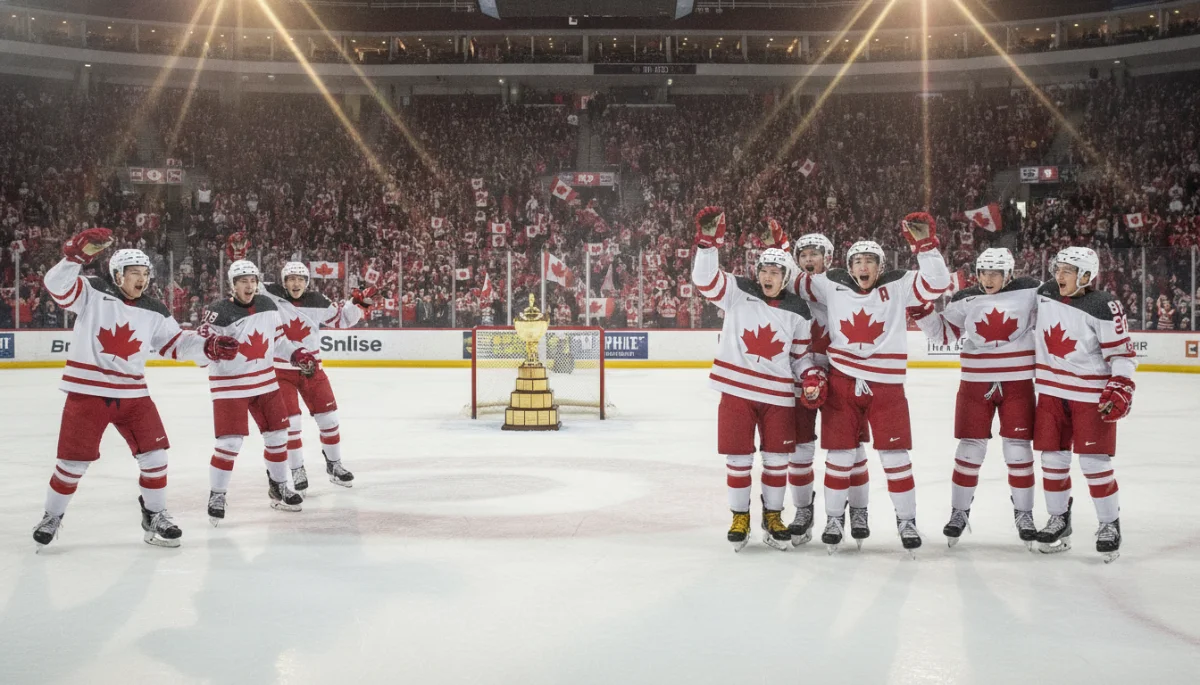
Canada is one win from the final after a perfect preliminary round at the 2026 Hlinka Gretzky Cup in Edmonton. The host team now turns to Finland in Friday’s semifinal, with a title game berth on the line at Rogers Place.
That setup gives Canada a clear goal and a short runway. Win on Friday, and the Canadians move straight into Saturday’s championship matchup against either the United States or Slovakia.
The Semifinal Schedule
Canada and Finland meet on Friday, August 7, 2026, in the semifinal round. The game is set for Rogers Place, where Canada has already built momentum in front of its home crowd.
- 5 p.m. Mountain Time
- 7 p.m. Eastern Time
- 4 p.m. Pacific Time
- 8 p.m. Atlantic Time
- 8:30 p.m. Newfoundland Time
The winner advances to the gold medal game on Saturday. The loser drops into the bronze medal game, which is scheduled earlier in the day.
What Canada Has Done So Far
Canada has looked like a complete team through the opening round. It swept Switzerland, Slovakia, and Sweden to finish first in Group A and reach the knockout stage with an undefeated record.
The Canadian attack has been the headline. Across those three games, the hosts scored 20 goals and put constant pressure on opponents with pace, depth, and confident puck movement.
- 7-3 over Switzerland
- 6-1 over Slovakia
- 7-4 over Sweden
That run was not just about offense. Canada also showed that it can sustain pressure for long stretches, then close out games when opponents push back.
Possible Final Opponents
If Canada gets past Finland, the championship opponent will be either the United States or Slovakia. Those two teams meet in the other semifinal, and the winner gets the late Saturday game.
| Team | Preliminary Round | Notable Detail |
|---|---|---|
| United States | Perfect record in Group B | Defending champion |
| Slovakia | Second in Group A | Already lost to Canada 6-1 |
A meeting with the United States would create a matchup between the two unbeaten teams from the preliminary stage. The Americans beat Czechia, Finland, and Germany while allowing only six goals.
A meeting with Slovakia would bring a familiar opponent back into view. Canada handled Slovakia 6-1 earlier in the tournament, but Slovakia still has a dangerous scorer in Tomas Selic, who led all players with eight points after the opening round.
Why Finland Is a Real Test
Finland enters the semifinal with confidence of its own. It beat Germany, fell to the United States, then responded with a narrow 5-4 win over Czechia to secure a place in the final four.
That makes Finland a different type of challenge than Canada faced in the preliminary round. The Finns are not likely to control the puck as much, but they can survive pressure and wait for chances in transition.
Goaltender Samu Heikkinen may decide how long Finland can stay in the game. He stopped 38 shots against Czechia and carried a .922 save percentage after the preliminary round, one of the top marks in the tournament.
For Canada, the key will be patience. If the first wave does not score, the second and third chances matter just as much.
Canadians to Follow Closely
Canada’s scoring depth is the biggest reason the team looks so dangerous. The production has come from multiple lines, and the defense has joined the offense as well.
- Maddox Schultz has led Canada in points with one goal and six assists.
- Liam Pue has been the top goal scorer with four goals and two assists.
- Kayden Stroeder has posted three goals and three assists, including a strong game against Sweden.
- Landon DuPont has added offense from the blue line while helping move the puck quickly out of trouble.
- Leif Oaten may be asked to make key saves if the semifinal becomes tight.
Schultz has been the main playmaker, finding teammates in space and driving the attack with vision. Pue has finished chances around the net, which could matter even more against a Finnish team that will try to keep the game compact.
Stroeder has been one of the most reliable forwards, producing in different situations and giving Canada another dangerous option. DuPont, meanwhile, has stood out because of his poise and his ability to turn defense into quick offense.
Oaten’s role may be less visible, but it could still be decisive. If Finland generates quick counterattacks or special-teams looks, Canada will need a steady last line of defense.
What Canada Must Get Right
Canada’s biggest strength is also its biggest responsibility: it cannot take control for granted. Against Sweden, the Canadians built a large lead, then allowed the game to open up more than necessary.
That kind of slip could become costly against Finland. The semifinal is the point where small mistakes can end a tournament run.
Three areas will matter most:
- Discipline — unnecessary penalties would hand Finland chances it does not need to earn.
- Puck management — turnovers through the middle of the ice could feed Finnish counterattacks.
- Net-front work — Canada should look for screens, rebounds, and second chances rather than low-percentage shots from far out.
If the Canadians stick to that formula, they should generate enough offense to reach the final. If they drift away from it, Finland has already shown it can make teams sweat.
Why This Team Feels Built for a Deep Run
Canada has not depended on one superstar to carry the load. That balance is part of what makes the team hard to defend over three periods.
Four Canadians finished the preliminary round among the tournament’s top seven scorers, with Schultz, Pue, Stroeder, and Ryerson Edgar all contributing at a high level. The defense has also helped, with DuPont, Jaakko Wycisk, Brock Cripps, and Alexis Joseph adding points from the back end.
That spread of offense forces opponents to make difficult choices. If one line is contained, another can break through. If the forwards are bottled up, the defense can start the next attack.
Canada also has the advantage of playing in Edmonton, where the crowd has already helped create a tournament atmosphere that favors the hosts. That does not guarantee anything, but it does add energy at a time when every detail matters.
How Close Is Canada to Gold?
Canada entered the event chasing its record-extending 26th summer under-18 gold medal. The program has won 25 of the 34 gold medals awarded since the tournament began in 1991, which shows how often it has reached this stage.
The Canadians last won the event in Edmonton in 2024, so another strong home showing would fit the pattern. They have the scoring, the blue-line support, and the depth to make that happen.
Still, none of that matters until Finland is cleared. Friday’s semifinal is the only thing standing between Canada and a shot at another championship night at Rogers Place.