The 2026 FIFA World Cup will arrive with more than a larger field and three host nations. It will also bring a fresh set of rule adjustments that could change how referees manage games and how teams approach key moments.
The main goals are clear: cut down on delay, tighten discipline, improve clarity for officials, and give video review a broader role in specific situations. For players and coaches, that means the tournament will reward discipline and quick decision-making more than before.
Why the Changes Matter
Football lawmakers have pushed these updates to make matches easier to control and less vulnerable to gamesmanship. In practical terms, that means fewer slow restarts, stronger responses to confrontations, and more consistency when technology is used to correct obvious mistakes.
The World Cup is a major testing ground for those ideas. Because the tournament draws global attention, even small rule tweaks can influence tactics, emotions, and match flow.
Discipline Will Be Tighter in Heated Moments
One of the most talked-about updates concerns players who cover their mouths during confrontations. Under the new approach, doing so with a hand, shirt, or arm in a tense exchange may be treated as a red-card offense if it appears designed to hide abusive or discriminatory language.
The point is not to punish every quiet exchange. The rule is aimed at moments when there is conflict, suspicion of misconduct, or an effort to conceal what was said. A casual conversation between opponents would not automatically trigger punishment, but a heated interaction could lead to serious consequences.
This matters because it gives referees a clearer basis for action. It also signals that attempts to hide offensive comments will be taken seriously rather than treated as harmless behavior.
Protests, Walk-Offs, and Restart Control
The updated laws also target protests that interrupt the match. If a player leaves the field in protest over a referee’s decision, a red card may follow. Team staff who encourage players to do that can also be sanctioned.
There is more at stake than individual discipline. If a team’s actions lead to an abandonment, the match could be forfeited. That makes walk-offs a far riskier form of protest and gives officials a stronger deterrent against collective disruption.
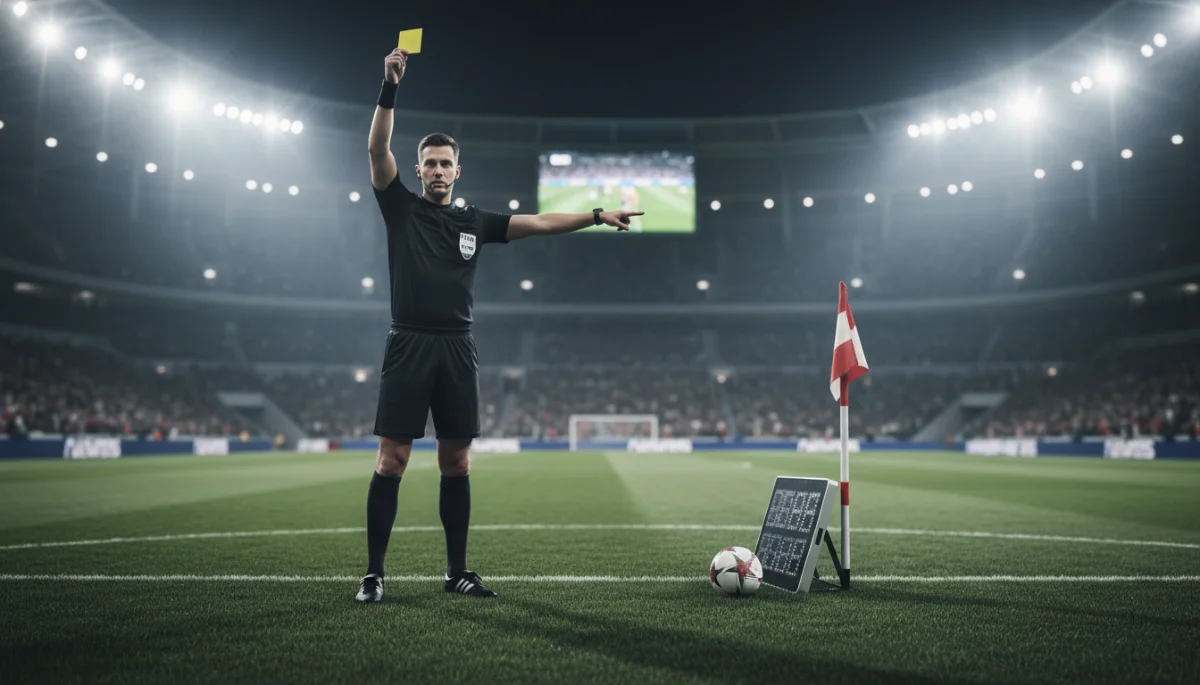
Referees will also have new tools to speed up restarts. A visible five-second countdown will apply to certain throw-ins and goal kicks. The referee raises a hand, counts down, and expects the restart to happen before time runs out.
- If a throw-in is not taken in time, possession goes to the other team.
- If a goal kick is delayed beyond the countdown, the opposition receives a corner kick.
- If a substitution drags on too long, the entering player may have to wait, and the team could be short temporarily.
Those penalties are designed to make time-wasting much less attractive. A delayed goal kick, for example, is no longer just a minor annoyance. It can create a direct scoring chance for the opponent.
Substitutions, Treatment, and Match Tempo
Substitutions are being handled more strictly as well. Once the board is shown, the player leaving the field will have 10 seconds to exit, and the exit should happen at the nearest boundary point instead of a slow walk across the pitch.
There are sensible exceptions. Referees can allow more flexibility for injuries, security concerns, or other safety issues. Still, ordinary delays are likely to be managed more aggressively than fans are used to seeing.
Medical stoppages are also being adjusted. If an outfield player receives treatment on the field, that player will generally have to leave for one minute once play resumes. The purpose is to reduce tactical breaks disguised as minor injuries.
Several situations are excluded from that rule, including goalkeeper injuries, collisions involving a goalkeeper and an outfield player, teammate collisions requiring care, serious injuries such as possible head trauma, and cases where a player is about to take a penalty. Those exceptions keep player safety ahead of game management.
Video Review Will Reach More Situations
VAR is also set to play a wider role. The system, which first appeared at a World Cup in 2018, will be available in more types of review at the 2026 tournament.
One important change involves second yellow cards. If a player is wrongly sent off because of a second caution that is clearly incorrect, VAR may intervene. That is a notable shift because those decisions have often fallen outside the usual review scope.
VAR can also correct mistaken identity, such as when the wrong player is booked or dismissed. In addition, certain wrongly awarded corner kicks may be reviewed if the correction can be made quickly without causing major delay.
The most interesting extension may involve fouls that happen before a free kick or corner is actually taken. If an attacker fouls a defender before the ball is in play, VAR may recommend an on-field review. If the referee agrees, the disciplinary decision can be changed and the restart adjusted.
What Fans Should Expect on Match Day
Supporters will probably notice a more controlled rhythm. Referees may be more visible during substitutions, restarts, and set pieces, and some decisions could come faster because the rules now demand quicker action.
Hydration breaks will also be part of every match. With the tournament spread across the United States, Mexico, and Canada, heat will be a real factor. Each half is expected to include a three-minute hydration pause, usually around the middle of the half, though the referee can shift the timing if another stoppage happens nearby.
Goalkeeper injuries will receive special treatment as well. The new framework is meant to prevent a team from turning that stoppage into a hidden coaching session. In other words, an injury break is for treatment, not an unofficial timeout.
For fans, the overall picture is simple: the tournament should move faster, feel tighter, and give referees more authority in situations that once created confusion. Teams that adapt quickly will be better prepared, while teams that lean on delay, protest, or gamesmanship may pay a bigger price.