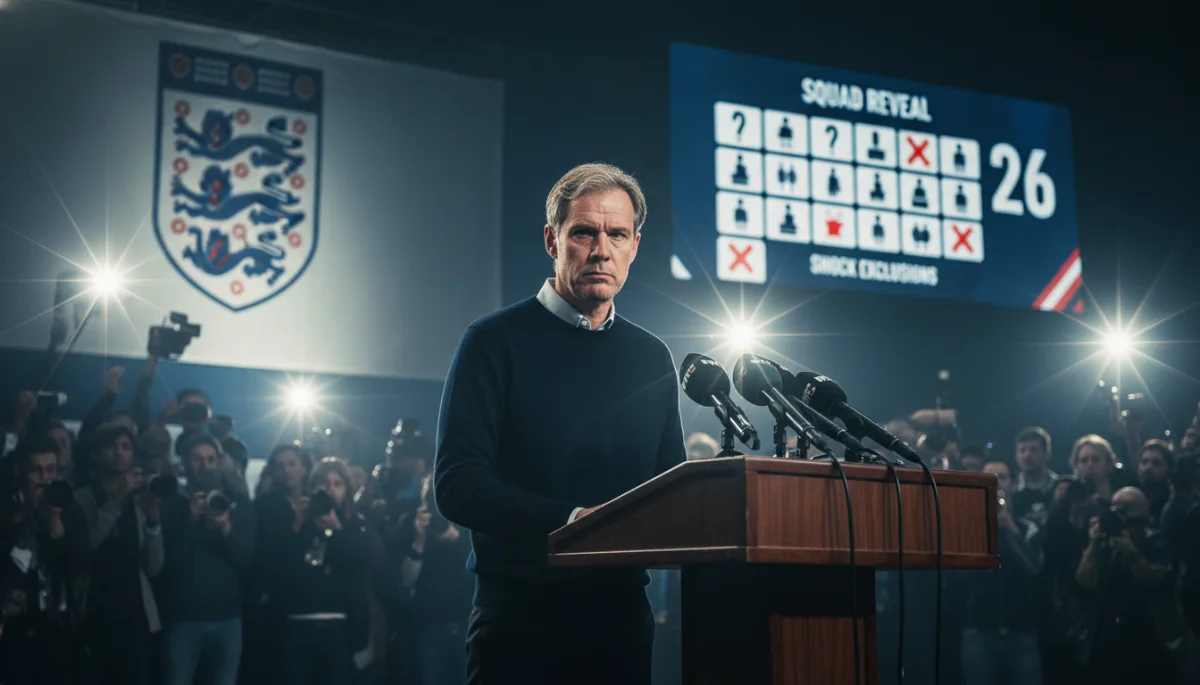
Thomas Tuchel has made his first major tournament statement with England, and he has done it in a way that guarantees debate. His 26-man World Cup squad for North America leaves out several familiar names, while also rewarding players who have impressed him in recent international camps.
Tuchel made no effort to disguise how hard the process was. He described the decisions as the kind a head coach must face, even when they are painful, and that frankness only added to the shock when the final list became public.
The most surprising omissions
The biggest talking points are the players who did not make the cut. Cole Palmer, Phil Foden, Trent Alexander-Arnold, and Harry Maguire are the names that will dominate the post-announcement discussion, because all four would have seemed near-locks in a different era.
Palmer and Foden stand out most sharply. Both had seasons that fell short of the standards they set for themselves, and Tuchel also had to weigh the crowded attacking pool around them. England have an abundance of creators and wide players, so even high-profile talent can be pushed aside when there are too many similar options for too few spots.
Alexander-Arnold’s absence feels bold, but not entirely unexpected. The right back has not added to his England tally since last summer, and his recent lack of involvement in national team camps meant he entered the final selection without much momentum.
Maguire’s reaction was immediate and emotional. He said he was shocked and disappointed to miss out, reflecting the kind of emotional hit that comes with a tournament squad call. The broader picture had already started to leak before the formal announcement, which meant the suspense was slowly replaced by grim certainty for several players.
One observer summed up the reaction by calling it the most stunning England squad decision in decades, and that may not be much of an exaggeration given the scale of the omissions.
Tuchel leans into balance and trust
The most important theme behind the squad is not just who was selected, but why. Tuchel has made it clear that he is building around chemistry, balance, and familiarity. He pointed to the group that performed well across the autumn international windows, when England looked stable and cohesive, as the benchmark for this selection.
That approach explains why several trusted faces stayed in place. Rather than chase reputation alone, Tuchel appears to believe that tournament success depends on a group that already understands his ideas and can operate with minimal adjustment once the competition begins.
He also stressed that some decisions were made with roles in mind, not simply overall quality. In other words, he did not want to bring several players who filled the same tactical lane if it meant leaving the squad unbalanced or asking someone to play out of position.
- He favored players who fit the same tactical rhythm that worked in autumn.
- He reduced duplication in key positions to keep the squad flexible.
- He accepted that some difficult exclusions were the price of maintaining balance.
Fresh faces and renewed chances
There was still room for optimism in the final group. Ivan Toney is one of the most notable recalls, with the striker’s move to Al-Ahli not preventing Tuchel from giving him another chance in the England setup. His presence gives the squad a different attacking option from Harry Kane, which could matter if England need a change of pace or style in a knockout game.
The younger contingent also received strong backing. Djed Spence, Kobbie Mainoo, Eberechi Eze, Noni Madueke, Jarell Quansah, and John Stones are among the players who survived the cut and reflect Tuchel’s willingness to mix established names with developing talent. The balance suggests a squad that is not built only for the present, but also for adaptability if the tournament forces unexpected adjustments.
That combination of trust and freshness is likely to become one of the central arguments around the squad. Supporters will see ambition in the new selections, while critics will focus on the stars left behind. Tuchel, meanwhile, has clearly chosen conviction over caution.
The full squad and what it says
England’s final 26 is a picture of Tuchel’s priorities. In goal, Jordan Pickford, Dean Henderson, and James Trafford form the goalkeeper group. At the back, Reece James, Ezri Konsa, Jarell Quansah, John Stones, Marc Guehi, Dan Burn, Nico O’Reilly, Djed Spence, and Tino Livramento make up a defense that blends experience, athleticism, and versatility.
The midfield includes Declan Rice, Elliot Anderson, Kobbie Mainoo, Jordan Henderson, Morgan Rogers, Jude Bellingham, and Eberechi Eze, while the attack features Harry Kane, Ivan Toney, Ollie Watkins, Bukayo Saka, Marcus Rashford, Anthony Gordon, and Noni Madueke.
On paper, the group is not built to please every supporter. Instead, it is designed to preserve the structure Tuchel trusts most. That is the real gamble: not just selecting the best names individually, but betting that continuity, role clarity, and collective timing will matter more than the reputations that were left behind.
Once England step onto North American soil, the debate will not disappear. It will simply move from selection day to the matchday lineups, where Tuchel will have to prove that these controversial calls were the right ones all along.